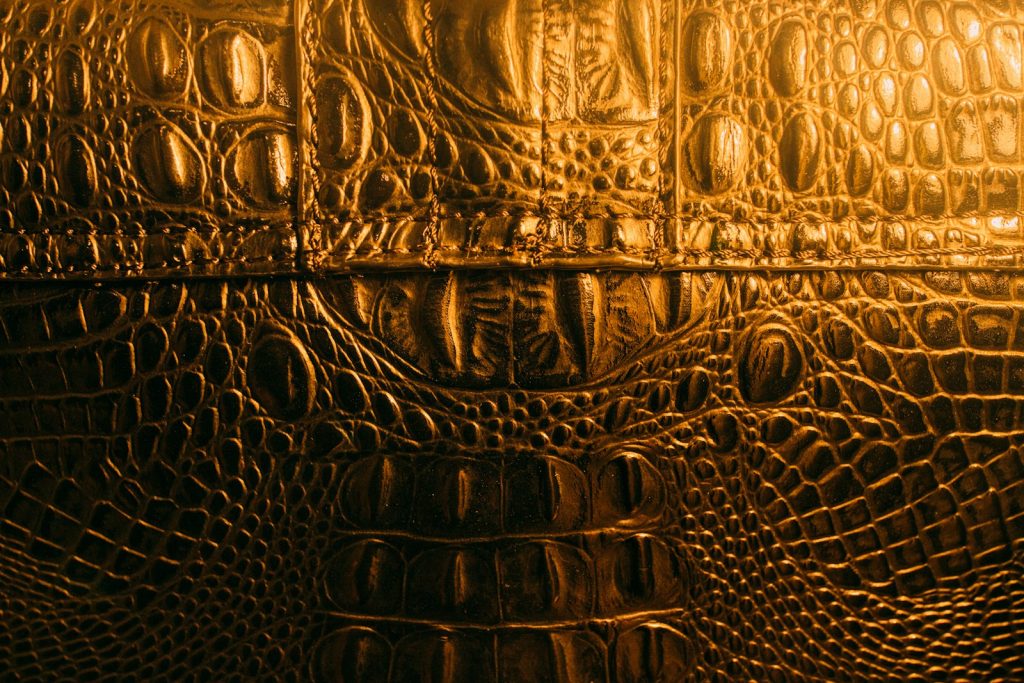
Honest sourcing note: “Crocodile”, “alligator” and “caiman” are different species. The premium crocodilian is saltwater crocodile (Crocodylus porosus); Nile crocodile (C. niloticus) is very high but usually below porosus; American alligator (Alligator mississippiensis) is a separate prized category; caiman is the entry tier. We label species accurately and never sell embossed calf as exotic. Genuine crocodilian is CITES-regulated (typically Appendix II, farmed/ranched, source codes C/F/R); international orders ship with documentation, and you are responsible for your country’s import rules — this is general information, not legal advice. Prices are indicative ranges (mid-2026); final pricing is by quote. Luxury houses are referenced only as neutral examples — we have no affiliation. We are an independent authority and sourcing desk and connect you to vetted makers.
An alligator handbag is a bag made from the hide of the American alligator (Alligator mississippiensis), the only true alligator species used in luxury leather. On this page we treat the alligator handbag as its own category—distinct from crocodile and caiman—because the leather behaves differently, is regulated differently, and is collected differently.
What Makes an Alligator Handbag Different?
The American alligator bag occupies a very specific niche in exotic leather. It is:
– A separate species from crocodiles and caiman
– Almost entirely US‑sourced and farmed/ranched
– Known for rounded, irregular belly scales and a soft, “quiet” hand
– Often finished in matte rather than the ultra‑high-gloss seen on some crocodiles
Luxury houses use “alligator” and “crocodile” precisely for a reason: they are not interchangeable materials. As Materials, Craft & Care Editor at Crocodile Leather Bags, my job is to unpack those differences in terms of how the leather actually behaves in a handbag.
The Only True Alligator: Alligator mississippiensis
Species: Not Just Marketing Language
There is only one commercially important “true alligator” in luxury leather:
– American alligator (Alligator mississippiensis) – native to the southeastern United States, the only alligator routinely used for high-end leathergoods.
By contrast, most “crocodile” bags you see are one of two species:
– Saltwater crocodile (Crocodylus porosus) – “porosus”, the top tier crocodile species for ultra-luxury bags
– Nile crocodile (Crocodylus niloticus) – “niloticus”, very high quality, usually positioned just under porosus
And then there is:
– Caiman (mostly Caiman crocodilus / Caiman yacare) – more affordable, with heavy bony plates (osteoderms), stiffer, and clearly a different category
We treat American alligator = A. mississippiensis as a separate, prized category, not “just another crocodile”.
CITES & Legality (High-Level Guide, Not Legal Advice)
Alligator and crocodilian trade is tightly regulated under CITES (the Convention on International Trade in Endangered Species). For American alligator:
– Typical CITES status: Appendix II
– Typical source codes on permits:
– C – Captive-bred
– F – Born in captivity (F1–F2, etc.)
– R – Ranched (eggs or juveniles taken from the wild and raised on farms under management programs)
Most American alligator handbag leather on the market is farmed or ranched in the US, then tanned by specialist exotics tanneries. Export of raw skins and finished products requires CITES documentation.
This page is *not* legal advice. Final responsibility sits with the buyer and brand to confirm requirements with their own national CITES Management Authority before importing or exporting any alligator or crocodile bag.
How to Recognize True American Alligator Leather
Alligator leather has visual and tactile cues that set it apart from both crocodile and embossed calf. Understanding these details is crucial if you’re paying alligator prices.
1. Belly Scales: Rounder and More Irregular
On a high-quality alligator leather handbag with a belly cut:
– Scale shape: The central belly scales are typically rounder or softly square, not long rectangles.
– Irregularity: Compared to porosus or niloticus, alligator belly scales vary more in size and spacing, with subtle asymmetries. Collectors value this “organic” look.
– Transition zones: As you move towards the flanks, scales change size and shape more noticeably than on many crocodile hides.
If you see perfectly uniform, brick-like rectangular scales, there’s a good chance you’re looking at a crocodile (porosus/niloticus) rather than A. mississippiensis.
2. No Big “Pores” in the Center of Each Scale
Under magnification or even close naked-eye inspection:
– Porosus crocodile: Tiny, visible “pores” near the edge of each scale (these are integumentary sense organs).
– Nile crocodile: Fewer and often less visible, but still can show tiny dots.
– American alligator: Virtually no obvious dot-like pores on the scale surface, especially on well-finished leathers.
If you see very clean, pore-free belly scales with lightly rounded shapes, that’s consistent with alligator.
3. Softer Hand and “Quiet” Flex
As a material:
– Alligator tends to feel slightly thicker yet more supple than many equivalent crocodile skins used for bags.
– When you flex an alligator leather handbag, it often feels “quiet” and damped, without the stiff creaking you might get from caiman or lower-grade exotics.
– The edges of scales are softer and less sharply ridged to the touch.
That flexibility is one reason many collectors prefer a true alligator purse for everyday use over more rigid caiman or low-grade crocodile.
4. Embossed Calf vs Genuine Alligator
Embossed calf is often sold—or mis-sold—as “alligator” or “gator”. We never do this. Key differences:
– Pattern repetition: Embossed calf shows repeated tile patterns if you look across a large area. Genuine alligator never repeats that perfectly.
– Texture depth: Embossing presses a pattern into a flat hide; the scale edges tend to feel shallow and uniform. Real alligator has depth differences from scale to scale.
– Cut lines: On a genuine alligator handbag, patterns follow the natural lines of the animal (belly center, flank transitions, tail taper). Embossed calf doesn’t have these anatomical “stories.”
If a brand can’t tell you the exact species and cut (e.g., “American alligator belly”), be cautious.
Alligator vs Crocodile vs Caiman – Practical Comparison
Below is a practical comparison framed the way collectors actually evaluate skins for handbags:
| Aspect | American alligator (A. mississippiensis) |
Saltwater crocodile (C. porosus) |
Nile crocodile (C. niloticus) |
Caiman (e.g. Caiman crocodilus) |
|---|---|---|---|---|
| Typical tier | Separate prized category | Top tier “premium crocodile” | Very high, just below porosus | Entry / lower tier exotic |
| Scale shape (belly) | Rounder, more irregular | Small, refined rectangles | Larger rectangles, more pronounced | Often irregular, but disrupted by bony plates |
| Pores / dots on scales | Generally not visible | Fine visible pores on many scales | Some pores visible | Varies, but osteoderms dominate feel |
| Hand / flexibility | Supple, “quiet” flex | Supple in high grades, very refined | Supple, slightly more robust feel | Noticeably stiffer, can feel “boardy” |
| Common finish for bags | Often matte; glazed less common but exists | Both matte and intense glazed | Both matte and glazed | Usually high-gloss to compensate for stiffness |
| Typical origin | USA farms/ranches | SE Asia / Australia farms | Africa farms/ranches | Latin America |
| Typical bag price position* | High / ultra-high | Ultra-high | High | Low / mid-exotic |
*Pricing is indicative only, last verified June 2026. Final pricing always by quote and influenced by design, brand, grade and finish.
Why Collectors Treat Alligator as Its Own Category
1. A Different Visual Language
Collectors don’t choose an alligator leather handbag because it “looks like crocodile”. They choose it because:
– The rounded, gently irregular scales feel less formal and more organic.
– The matte surface many tanneries favor on alligator gives off a low‑sheen, “quiet wealth” vibe that is hard to mimic in calf or even crocodile.
– From a distance, a true alligator purse is less about shine and more about texture and depth.
Think of porosus as razor-sharp tailoring; think of American alligator as a perfectly cut, slightly softer jacket in the same echelon.
2. How It Ages
Alligator leather tends to:
– Develop a soft, satiny patina rather than a mirror gloss (on matte finishes).
– Hold structure well in properly lined bags, but relax slightly in high-use areas (flaps, handles) in a way many owners appreciate.
– Show fine creasing along natural scale boundaries, not random surface cracking, if properly conditioned and kept away from extreme heat/dryness.
The underlying collagen structure and the way alligator is tanned contribute to this characteristic aging.
3. Use in Ultra-Luxury Without Overlap
Top houses (e.g., Hermès, Louis Vuitton, Gucci and others—named here purely as public examples, with no affiliation or claim of relationship) treat alligator, porosus crocodile, niloticus and caiman as four distinct materials in their public catalogs and price ladders.
That separation is not arbitrary:
– Porosus is often used when ultra-fine, tiny scales and intense glazing are desired.
– Alligator often appears in more understated, frequently matte executions.
– Niloticus frequently fills a slightly more robust, sometimes larger-scale aesthetic.
– Caiman is used for entry-level exotics or where high rigidity is acceptable.
We follow that same clarity in our language and sourcing: species always stated, never blurred.
Cuts, Panels and Skins-Per-Bag in American Alligator
How many skins an alligator handbag uses—and which parts—depends on scale layout and bag size.
Common Cuts for Alligator Bags
– Belly cut (classic)
– The hide is split along the back, exposing the belly and flank as one main panel.
– Used for: flap bags, totes, top-handles where you want large, flat scales front and center.
– Hornback / back cut
– The cut preserves the raised dorsal “spikes” along the spine.
– Used more in belts and boots than in formal handbags, but some structured designs use hornback for accent panels or clutches.
Most alligator handbags in the classic sense are belly-cut front and back, because that’s where you find enough flat real estate for a visually cohesive panel.
How Many Skins for an Alligator Handbag?
As a rule of thumb, based on typical female alligator farming sizes and commercial bags:
– Small clutch / mini bag
– Often 1–2 skins if pattern placement allows, sometimes using flanks for sides/gussets.
– Medium top-handle or shoulder bag (the typical collector’s “alligator handbag”)
– Commonly 2–3 skins, depending on
– Bag dimensions
– Whether grain matching is required front/back
– Handle/strap length (long shoulder strap segments can require extra panels)
– Large tote or travel bag
– Can require 3–5 skins to maintain consistent scale size and alignment across front, back, side panels and base.
Why it matters: Each additional skin increases not just material cost but also matching work—aligning scale size, direction and character so the bag reads as a unified whole, not a patchwork.
Grading and Selection: What “Premium Alligator” Really Means
Typical Grading Factors
High-grade alligator handbag leather is evaluated on:
– Defects – scars, holes, deep scratches, insect bites, brand marks
– Scale regularity – even but naturally varied scale development across the belly
– Size – larger usable belly area allows panel cutting without stitching through focal areas
– Tanning quality – clean crust, consistent dye penetration, membrane removal, and fineness of finish
For a visually clean front panel, brands often insist on Grade I or equivalent, which means virtually no visible flaws in the main cut lines of the bag.
What This Feels Like on a Finished Bag
On a premium alligator leather handbag, expect:
– Minimal visible scarring on main faces; small marks, if any, are pushed to less visible zones (under flaps, side gussets).
– Scale progression that looks intentional: slightly smaller scales at the top, enlarging toward the middle.
– Edge finishing that respects scale corners so they don’t lift or snag prematurely.
Lower-grade skins can absolutely be used for more rustic styles, but they should be priced and described honestly as such.
Finishes: Matte vs Glazed Alligator
Matte Alligator (Most Common in High-End Bags)
Most collector-grade American alligator handbags today are matte. That usually means:
– Satin, low-sheen surface – not dull, but no mirror effect.
– You can see the grain structure in the valleys between scales.
– Scratches tend to blend more easily with light buffing than on intense glazed surfaces.
– Feels soft and natural in the hand, with a subtle drag rather than a slippery gloss.
Many ultra-luxury houses publicly favor matte alligator for “everyday-exotic” bags because it reads quieter and ages gracefully.
Glazed Alligator (Less Common but Available)
Glazed alligator exists and can be spectacular when done right:
– Achieved by mechanical glazing (polishing, often with glass or agate rollers) on carefully prepared crust.
– Surface is mirror-bright, with strong reflections.
– Emphasizes color saturation and scale outlines.
However, very high-gloss finishes highlight any irregularities and can show wear or micro-scratches more starkly. That is one reason you see matte alligator more frequently in high-rotation bags, with glazed reserved for evening pieces or collectors who appreciate the formality.
Exotics Honesty: What We Will and Will Not Call “Alligator”
Our rule at Crocodile Leather Bags is simple:
– American alligator = Alligator mississippiensis, CITES App. II, legally sourced.
– Premium “crocodile” = Crocodylus porosus (“porosus”).
– Nile crocodile = Crocodylus niloticus (“niloticus”).
– Caiman = Caiman species.
– Embossed/printed calf = not exotic, never called alligator/crocodile/caiman.
If the species or origin cannot be documented, we do not list or recommend it. If you ask our sourcing desk for an alligator leather handbag and the maker only has caiman or embossed calf, we will say exactly that.
If you are planning a bespoke or wholesale project and need documented American alligator with clear species labelling and CITES paperwork, you can plan your trip with us via email or WhatsApp. We coordinate introductions and specifications; vetted makers do the tanning and crafting.
Pricing, MOQs and Lead Times for Alligator Handbags
Indicative Pricing Ranges (Last Verified June 2026)
Because we work across multiple makers and regions, and do not publish fixed price lists, all numbers here are broad ranges only for orientation, not quotes.
For American alligator handbags from reputable, CITES-compliant workshops, as of June 2026, indicative ex‑factory or workshop-level pricing:
– Small alligator clutch / mini bag (matte)
– Rough range: USD 2,500–6,000+ depending on grade, color and hardware.
– Medium alligator top-handle / shoulder bag (matte)
– Rough range: USD 4,000–12,000+.
– Porosus crocodile equivalents often sit at equal or slightly higher ranges for the same pattern and grade.
– Large alligator tote / structured bag
– Rough range: USD 7,000–18,000+, largely driven by skins-per-bag and grade.
Retail prices from global luxury brands will usually be significantly higher than these workshop-level numbers after design, branding, retail, duties and taxes.
All final prices are by quote only and depend on:
– Design complexity (hand-stitching, gussets, pockets, hardware)
– Skins-per-bag and grade
– Finish (matte vs glazed) and color (standard vs custom dye)
– Country of manufacture and compliance overhead
Minimum Order Quantities (MOQs)
Through our sourcing desk, typical patterns we see from vetted makers:
– Single bespoke piece – Usually possible with a higher per-unit cost.
– Small capsule runs (3–10 bags of one style) – Common for independent brands testing alligator.
– Larger wholesale orders – MOQs vary by workshop; some start at 10–20 units per style/color, others manage flexible boutique runs.
We coordinate expectations and help you match with a workshop whose MOQ, pricing approach and quality level fit your project.
Lead Times
Indicative timeframes from design sign-off and deposit (not counting CITES export/import processing):
– Bespoke one-off alligator handbags – Approximately 8–16 weeks, depending on skin availability and workshop queue.
– Small batch (5–20 pieces) – Often 10–20 weeks.
– Large or ongoing production – Timelines are usually phased and need direct planning with the maker.
CITES permits and international logistics can significantly affect delivery timing. Always build a buffer of several extra weeks or more if cross-border trade is involved.
How We Work: Independent Authority + Sourcing Desk
Crocodile Leather Bags is not a tannery and not a fashion house. Our role is:
– Editorial – We publish independent, technically accurate guides on crocodile, alligator and other exotics. No one can pay to change what we publish; if you proceed with our partner they may pay us a referral fee at no extra cost to you.
– Sourcing desk – We curate and connect serious buyers with vetted, CITES-compliant makers and workshops for bespoke or wholesale exotic-leather bags.
For American alligator bags specifically, we help you:
– Confirm species, cut and grade before you commit.
– Align on finish (matte vs glazed), color and hardware details.
– Understand CITES paperwork responsibilities on each side of the transaction.
– Communicate technical requirements (panel sizes, lining choices, reinforcement specs) so the finished handbag performs as expected.
If you’re a collector, designer or buyer planning a project in true American alligator, you can plan your trip with us via email or WhatsApp. We’ll help you frame a precise RFQ and match it to suitable makers.
Caring for an Alligator Leather Handbag
Alligator is resilient for an exotic, but it is not low-care like coated canvas. Treat it as you would a high-end calf bag, with a few extra precautions.
Daily Use & Handling
– Avoid overloading – Excess weight can stretch panels and stress stitch lines, especially across larger belly scales.
– Keep away from rough surfaces – Scale edges can scuff if dragged against abrasive walls, zips or concrete.
– Handle with clean, dry hands – Oils and cosmetics can gradually darken light colors, especially in Himalaya-like palettes.
Water and Moisture
– Alligator is not waterproof, even when treated.
– Light rain: Gently blot with a soft, absorbent cloth; let it air dry at room temperature, away from direct heat sources.
– Do not use hairdryers, radiators or direct sun to “speed dry” – that can cause the finish to tighten and crack.
Conditioning and Cleaning
– Routine dusting with a soft, dry cloth is usually sufficient.
– For deeper cleaning, use a pH-balanced leather cleaner specifically approved for exotics, sparingly, and spot-test on a hidden area first.
– Light conditioning (1–2× per year for frequently used bags) with a non-greasy, exotic-safe conditioner can help maintain flexibility.
– Avoid heavy waxes or oils; they can accumulate in scale joints and attract dirt.
When in doubt, consult the maker or a specialized exotic-leather spa rather than experimenting with generic products.
Storage
– Store stuffed but not overfilled, so the bag keeps its shape. Use soft, inert filling (acid-free tissue, clean cotton).
– Keep in a breathable dust bag, not sealed plastic. Leather needs minimal air exchange to avoid moisture build-up.
– Avoid long-term exposure to strong artificial light or sunlight, which can fade or discolor certain dyes, especially pale shades.
Sister Site: Alligator Watch Straps
For collectors interested in matching exotics, we also maintain a dedicated authority site for straps:
– alligatorwatchstrap.com – focused on exotic-leather watch straps (American alligator, crocodile, lizard and more), with the same species-level honesty and practical care guidance.
Many of the same grading and finish principles apply in miniature: belly vs flank, matte vs shiny, and how leather thickness and stiffness matter for daily wear.
FAQs: American Alligator Handbags
What exactly is an American alligator handbag?
An American alligator handbag is a bag made from the hide of Alligator mississippiensis, farmed or ranched primarily in the United States and traded under CITES Appendix II. It is a distinct material from crocodile and caiman, with rounder, more irregular belly scales, no obvious pores on each scale, and typically a matte, softly luxurious look and feel.
How is an alligator handbag different from a crocodile bag?
Compared to crocodile (porosus or niloticus), an alligator handbag usually has rounder and more irregular belly scales, a softer “quiet” flex, and minimal visible pores on the scales. Porosus crocodile shows smaller, more regular rectangular scales with tiny dot-like pores and is often used in very high-gloss finishes. Both sit at the high end of the exotic spectrum, but they offer different aesthetics and tactile experiences.
Is alligator leather only matte, or can it be glazed?
American alligator is often produced in matte for handbags, especially by ultra-luxury brands that favor an understated look, but it can also be glazed to a strong shine. Matte remains more common for high-rotation day bags, while glazed alligator is usually chosen for more formal or statement pieces where a mirror finish is desired.
How much does a real American alligator bag cost?
Indicatively, as of June 2026, workshop-level pricing for genuine American alligator handbags from reputable, CITES-compliant makers often ranges from about USD 2,500–6,000+ for small clutches, 4,000–12,000+ for medium top-handle or shoulder bags, and 7,000–18,000+ for large totes, depending on grade, finish, color, design complexity and skins-per-bag. Final prices are always by quote and retail prices from major brands are typically higher.
How can I commission or source a true alligator purse responsibly?
You can work through our sourcing desk at Crocodile Leather Bags. We help you define the exact specification (American alligator, species-labeled, belly or hornback, matte or glazed), then connect you with vetted, CITES-compliant makers who can quote, craft and document your bag. You can plan your trip with us via email or WhatsApp; no one can pay to change what we publish, and if you proceed with our partner they may pay us a referral fee at no extra cost to you.