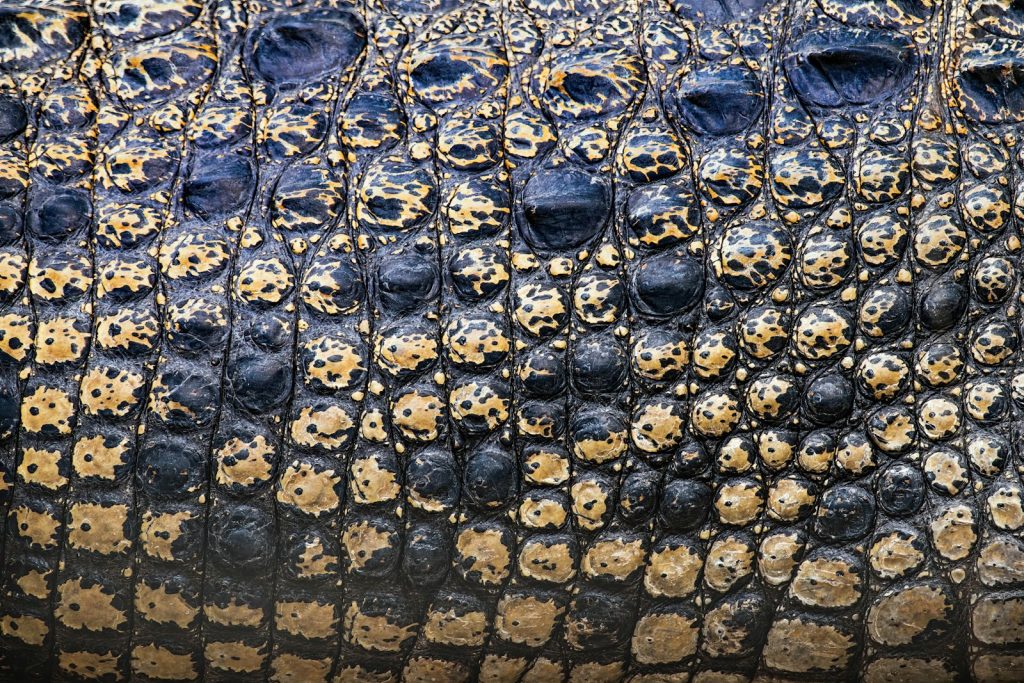
Honest sourcing note: “Crocodile”, “alligator” and “caiman” are different species. The premium crocodilian is saltwater crocodile (Crocodylus porosus); Nile crocodile (C. niloticus) is very high but usually below porosus; American alligator (Alligator mississippiensis) is a separate prized category; caiman is the entry tier. We label species accurately and never sell embossed calf as exotic. Genuine crocodilian is CITES-regulated (typically Appendix II, farmed/ranched, source codes C/F/R); international orders ship with documentation, and you are responsible for your country’s import rules — this is general information, not legal advice. Prices are indicative ranges (mid-2026); final pricing is by quote. Luxury houses are referenced only as neutral examples — we have no affiliation. We are an independent authority and sourcing desk and connect you to vetted makers.
A crocodile briefcase is a structured business case made with genuine crocodilian leather panels – typically two to three full skins – engineered for daily executive use. On this page, “crocodile briefcase” always means real exotic leather (porosus, niloticus, American alligator, or caiman), never embossed cowhide or printed calf.
As Lead Editor for Crocodile Leather Bags, my job is to separate marketing language from verifiable facts: correct species, correct cuts, and realistic expectations about price, durability, and legality. This is a long-form reference for collectors and professionals considering a crocodile leather briefcase or other exotic leather briefcase on a bespoke or wholesale basis.
—
## What Counts as a True Crocodile Briefcase?
A true crocodile briefcase is:
– Built from genuine crocodilian skins (or American alligator), not embossed bovine leather.
– Panelled to cover the main faces in exotic leather, often with matching gussets and handles.
– Structured to hold documents, laptop, and small tech with reinforced frame and hardware.
Typical layout:
– 1 or 2 main compartments
– Interior zip and slip pockets
– Top handle (sometimes two)
– Optional shoulder strap with metal anchor points
– Lockable or latch-style hardware at the flap
For business travel and boardroom use, the mens crocodile briefcase is usually in the 38–42 cm width range (15–16.5″), sized for a laptop and A4 documents, with a profile thickness around 8–12 cm.
—
## Species: Porosus, Niloticus, American Alligator, and Caiman
Correct species labelling matters more in briefcases than in small goods. You are buying multiple skins and significant visible surface area; mislabelling here is expensive.
### Premium “Crocodile” Tiers
We use the following taxonomy consistently:
– Saltwater crocodile – Crocodylus porosus (“porosus”)
– Highest commercial tier.
– Fine, tight belly scale pattern with small, even tiles.
– Often seen in flagship lines from top luxury houses (example: Hermès, Louis Vuitton, Gucci – mentioned here purely as public references, no affiliation).
– Usually farmed/ranched, CITES Appendix II.
– Nile crocodile – Crocodylus niloticus (“niloticus”)
– Very high quality, slightly larger scales than porosus and a somewhat more pronounced pattern.
– Widely used across premium bags and briefcases.
– Typically less costly than porosus at equivalent grade and size.
– Also farmed/ranched, CITES Appendix II.
– American alligator – Alligator mississippiensis (“alligator”)
– Not taxonomically a crocodile, but functionally in the same luxury category.
– Very prized for soft hand and often used in matte finishes.
– CITES Appendix II, heavily managed and regulated; wild and farmed sources exist.
– Caiman – mainly Caiman crocodilus fuscus (“caiman”)
– More rigid because of pronounced bony plates (osteoderms) under the scales.
– Lower tier in comfort and long-term flexibility, especially in structured goods.
– Much lower cost per skin, but also more difficult to achieve high-end finishing.
We will never call caiman “porosus” or “alligator”, and we do not describe embossed calf as “exotic leather” at all.
—
## Cuts and Aesthetics: Belly vs Hornback
For a crocodile leather briefcase, the cut – where the pattern is taken from on the animal – is crucial. Larger panels make this more visible than on a small clutch.
### Belly Cut (Flat Scales)
– Look:
– Flatter tiles, symmetrical pattern, smaller and more even on porosus; slightly larger on niloticus and alligator.
– Clean, formal appearance that suits corporate dress codes.
– Use in briefcases:
– Most high-end mens crocodile briefcases use belly cut for the front and back panels.
– Belly is also preferred for handles and strap accents because it is smoother in hand.
– Pros:
– Easier panel matching, more predictable grain.
– Sits comfortably under the arm and against clothing.
– Cons:
– Slightly more conservative visually.
– Premium-grade belly skins are more expensive.
### Hornback (Ridged Spine)
– Look:
– Raised, rugged ridges along the spine, very visible tactile texture.
– Visually assertive; reads as more “exotic” from distance.
– Use in briefcases:
– Often used on the flap only, or central panel, with belly cut on the main body.
– Full hornback briefcases are relatively rare due to bulk and comfort issues.
– Pros:
– Very distinctive; fewer pieces look similar.
– Natural armour-like aesthetic.
– Cons:
– Less comfortable against the body.
– Harder to panel-match and close up beautifully around corners.
– More prone to scuffing at the peak of ridges if mishandled.
—
## How Many Skins Does a Crocodile Briefcase Use?
Briefcase scale matters: unlike a watch strap, you are buying square footage, not just a “piece of exotic”.
Typical usage for a full-exotic crocodile briefcase (last verified June 2026):
– Porosus / Niloticus / Alligator
– 2 to 3 full skins for a classic two-gusset briefcase, assuming:
– Belly cut front and back panels from 1–2 larger skins
– Gussets, small components, and handle from remaining areas
– Larger, uniform-panel designs or very strict pattern-matching can require 3–4 skins, particularly in smaller belly-width porosus.
– Caiman
– 2–3 skins as well, but because caiman skins are often smaller and less regular, some makers will order an extra skin to allow for better cut selection.
For part-exotic cases (e.g. crocodile front panel only, with calf sides and back), a single high-quality skin can be enough, though top-end work still may call for 1.5–2 skins for flexibility in pattern layout.
These are indicative ranges, not promises. The maker will determine final consumption once dimensions, pattern layout, and grade are fixed.
—
## Construction and Structure: What You Are Really Paying For
The skin is only the surface. A crocodile briefcase stands or falls on its structure and hardware.
### Frame and Body
High-end exotic leather briefcases typically use:
– Internal frame:
– Stiffener materials (board, fibre, or high-grade synthetics) to hold shape.
– Some makers use a wooden or metal reinforcement bar at the handle base.
– Lining:
– Fully lined in calf, goat, or suede; occasionally in textile for weight reduction.
– Sealed and skived edges at folds to avoid bulky seams that could stress the scales.
– Reinforced corners:
– Either in exotic leather with additional backing, or sacrificial corner caps in non-exotic leather or metal to reduce wear on the crocodile.
### Handles and Straps
– Handles
– Usually rolled or padded, with internal core for strength.
– Critical stress point; in a good build, the handle core is anchored into the internal frame, not just stitched through the skin.
– Shoulder strap
– Often made in matching exotic leather on the top face, lined with calf or another smoother, stronger leather.
– Heavy-duty hardware: cast brass or steel with plating (palladium, ruthenium, gold-tone, or gunmetal).
### Hardware and Closures
Common options:
– Traditional center lock with key
– Side latches with a central clasp
– Modern push-lock systems
Hardware should be:
– Solid metal (not hollow decorative)
– Screwed, not only riveted, for serviceability
– Finished edges around anchor points to avoid cutting leather over time
—
## Grades, Scars, and Panel Matching
With briefcases, panel matching is highly visible. You’re looking at large, flat fields of scales.
### Grading Basics (Farmed/Ranched Skins)
Most tanneries grade crocodile and alligator skins on criteria like:
– Scar presence and size
– Scale pattern regularity
– Natural imperfections (holes, defects)
– Bite marks or farm-related scars
Common internal naming: Grade I / I–II / II etc., but every tannery has its own exact system.
For a top-end crocodile leather briefcase:
– Premium builds often use Grade I or I–II for the main panels.
– Smaller components (straps, belt loops, interior tabs) may use lower-grade sections from the same or other skins.
### Panel Matching
Panel matching in a mens crocodile briefcase usually covers:
– Front vs Back symmetry:
– Similar scale size and density side to side.
– Alignment of the “center line” of belly scales.
– Left vs Right gusset or side panels:
– Tiled patterned mirrored or at least harmonized.
– Color / finish consistency:
– Same dye batch, or at least very close batches, especially on bright colors.
You are paying for skins and craftsmanship that minimize abrupt changes in scale height, width, or color between adjacent panels.
—
## Finishes: Gloss, Matte, and Semi-Matte
Finish is both visual and tactile, and it affects wear patterns.
– Gloss (polished)
– Achieved via glazing or mechanical polishing.
– More formal and “dressy”.
– Shows micro-scratches more readily but can also be re-polished by specialists.
– Matte
– Less reflective, often preferred for alligator and for understated corporate use.
– Hides minor wear better; feels softer in hand.
– Semi-matte / Satin
– Middle ground, often used on niloticus and porosus for daily-use bags.
– Balances presence with practicality.
Finish choice does not change the underlying species; a “matte crocodile briefcase” should still state whether it is porosus, niloticus, or caiman.
—
## Durability and Daily Use
A high-quality crocodile or alligator briefcase is built for regular use, not just display. With realistic expectations and care, it can last decades.
### Strength and Flexibility
– Porosus / Niloticus / Alligator
– Strong, supple fibers; good resistance to flex cracking if tanned correctly.
– Best choice for daily professional use.
– Caiman
– Stiffer, with more pronounced bony plates.
– Higher risk of scale-edge cracking in heavily flexed areas over time.
– More suitable for occasional use or parts of the bag that do not flex constantly.
### Typical Wear Points
– Corners (especially bottom corners)
– Handle bases and hardware anchors
– Flap edge where it bends repeatedly
Good construction mitigates these via reinforcement, smart pattern layout, and correct skiving.
—
## CITES, Legality, and Sourcing
All commercially traded modern crocodilian and alligator skins fall under the CITES framework (Convention on International Trade in Endangered Species of Wild Fauna and Flora).
### Appendix and Source Codes (High-Level)
Most porosus, niloticus, alligator, and caiman skins used in luxury briefcases are:
– CITES Appendix II – Trade is controlled but permitted with documentation.
– From farmed or ranched sources, typically carrying CITES source codes like:
– C – Bred in captivity
– F – Born in captivity (first-generation)
– R – Ranched (eggs or hatchlings collected from the wild and raised in controlled facilities)
Finished items crossing borders may require CITES export permits and, in some jurisdictions, import permits or additional documentation. Rules differ by country and can also change.
This page is not legal advice. Buyers and brands must verify current requirements with their national CITES Management Authority or customs professionals before shipment.
### How We Work as an Independent Sourcing Desk
Crocodile Leather Bags is:
– Not a tannery.
– Not a fashion house.
– An independent editorial authority plus a sourcing desk that:
– Vet makers and suppliers for consistent species labelling and CITES-compliant sourcing.
– Coordinate introductions and spec discussions for bespoke and wholesale crocodile and exotic-leather bags.
– Help clarify species, cut, grade, and construction choices for your briefcase project.
Our editorial standards are independent; no one can pay to change what we publish. If you proceed with a partner we introduce, they may pay us a referral fee at no extra cost to you.
If you’re planning a bespoke crocodile briefcase or an exotic leather briefcase program for your brand, you can plan your trip through the options with us—email or WhatsApp—before committing to a maker.
—
## Indicative Pricing: What a Crocodile Briefcase Costs
Pricing varies with species, size, finish, grade, lining, and the maker’s labour cost base. All ranges below are indicative only, last verified June 2026; final figures are always by quote.
For a full-exotic, belly-cut, structured mens crocodile briefcase:
– Porosus (Crocodylus porosus)
– Typically high end of the market.
– Indicative bespoke / specialist-atelier range: USD 8,000 – 12,000+
– Niloticus (Crocodylus niloticus)
– Slightly more accessible at similar build quality.
– Indicative range: USD 5,000 – 9,000
– American alligator (Alligator mississippiensis)
– Pricing overlaps high niloticus and porosus depending on finish and brand.
– Indicative range: USD 6,000 – 10,000
– Caiman (Caiman crocodilus fuscus)
– Lower raw skin cost, but still requires skilled labour.
– Indicative range: USD 4,000 – 7,000
Partial-exotic designs (e.g. crocodile front panel with calf body) may price below these ranges, but not drastically if built by the same workshop – labour and hardware remain similar.
Wholesale programs (multi-unit orders for brands or corporate gifting) can adjust pricing, minimum order quantity, and lead times. Expect MOQs to start at low double digits for consistent panel and color runs.
—
## Comparison: Species and Briefcase Use
| Species | Scientific Name | Typical Tier | Hand Feel | Best Used For |
|---|---|---|---|---|
| Saltwater crocodile (porosus) | Crocodylus porosus | Top tier | Fine, supple, tight scales | Flagship full-exotic briefcases, collectors |
| Nile crocodile (niloticus) | Crocodylus niloticus | Very high | Slightly larger scales, still flexible | Daily executive use, core luxury lines |
| American alligator | Alligator mississippiensis | Prized, separate category | Soft, often matte, very refined | Understated high-end briefcases |
| Caiman | Caiman crocodilus fuscus | Entry exotic | Stiffer with bony plates | Occasional-use or more decorative pieces |
—
## Custom and Bespoke Crocodile Briefcases
A bespoke crocodile briefcase is not just “pick a color”. It is a spec document that covers:
### 1. Species, Cut, and Finish
– Species: porosus, niloticus, alligator, or caiman.
– Cut: full belly, belly with hornback flap, or limited hornback accent.
– Finish: matte, gloss, or semi-matte.
– Color: classic black, deep brown, navy, or more directional hues.
### 2. Layout and Size
– External dimensions (width, height, depth).
– Number of gussets and compartments.
– Laptop size targeted and padding requirements.
– External pockets or minimalist slab faces.
### 3. Interior and Hardware
– Lining type: calf, goat, suede, or technical fabric.
– Pocket map: card slots, pen loops, zipped pockets, document dividers.
– Hardware color: palladium-tone, gold-tone, gunmetal, etc.
– Lock type: traditional key lock, combination, modern push-lock.
### 4. Monograms and Logos
– Discreet initials debossed inside or on a strap tab.
– Corporate projects: subtle logo inside, not large exterior branding, if desired.
Lead times for true bespoke full-exotic briefcases are often 8–16 weeks from final spec sign-off and deposit (indicative, last verified June 2026), because skins must be allocated, cuts planned, and fitting/prototyping scheduled.
To outline a spec or explore wholesale options, you can plan your trip through possible configurations with our team. We can also coordinate WhatsApp calls if you prefer live back-and-forth on photos and options.
—
## Care and Maintenance of a Crocodile Briefcase
Good care preserves both finish and structure.
### Daily Use Guidelines
– Avoid overloading the briefcase beyond its intended weight; the handle and gussets are designed for documents and tech, not as a travel trunk.
– Keep away from prolonged direct sunlight that can dry and fade finish.
– If the briefcase gets wet, blot gently with a soft cloth and allow it to dry naturally at room temperature – no hairdryers or radiators.
### Storage
– Store in a breathable dust bag, not sealed plastic.
– Use an internal support (acid-free paper or a soft insert) to maintain shape.
– Keep away from high humidity or very dry conditions.
### Cleaning and Conditioning
– Wipe with a clean, dry, soft cloth regularly.
– For heavier soiling, use a slightly damp cloth, then dry gently.
– Conditioning: only with exotic-leather-safe products, and sparingly. Over-conditioning can soften the structure excessively or affect finish.
– Deep restoration or refinishing (especially for gloss porosus) should be done by specialists accustomed to crocodilian skins.
—
## Our Role in the Exotic-Leather Ecosystem
Crocodile Leather Bags is designed for:
– Collectors evaluating a serious purchase.
– Brand teams building an exotic leather briefcase line.
– Retailers checking species claims and CITES context.
– Professionals who simply want a reliable, long-lived work bag and need to understand what they are buying.
We also maintain a sister specialist resource, alligatorwatchstrap.com, dedicated to watch straps and small exotic-leather goods, with the same standards for species accuracy and construction detail.
If you want a second opinion on a quote, a sanity check on species labelling, or an introduction to vetted makers for bespoke or wholesale, you can plan your trip with us via email or WhatsApp. We are happy to talk in real specifications: species, cut, skins-per-bag, grade, and realistic price ranges.
—
## FAQs
How many crocodile skins are used in a typical crocodile briefcase?
Most full-exotic crocodile briefcases use 2–3 skins, sometimes 3–4 if you specify large, uniform panels in high grade porosus or strict pattern matching. The maker will confirm final consumption once your dimensions and layout are set.
Is belly or hornback better for a mens crocodile briefcase?
Belly cut is better for daily executive use: it is flatter, more comfortable against clothing, and easier to panel-match cleanly. Hornback is more dramatic but less practical on large surfaces and is often limited to flaps or accent panels.
How durable is a crocodile leather briefcase for everyday work?
A well-made porosus, niloticus, or alligator briefcase is highly durable for regular office and travel use, provided it is not overloaded and is kept away from extreme moisture and heat. Caiman can be more prone to scale-edge cracking in high-flex areas, so it suits lighter or occasional use.
What does a high-quality crocodile briefcase cost?
Indicative bespoke pricing (last verified June 2026) ranges roughly from USD 4,000–7,000 for caiman, 5,000–9,000 for niloticus, 6,000–10,000 for alligator, and 8,000–12,000+ for porosus, depending on size, finish, grade, and maker. Final pricing is always by quote.
Are crocodile briefcases legal under CITES?
Porosus, niloticus, American alligator, and common caiman used in briefcases are generally traded under CITES Appendix II with appropriate permits and source codes (C, F, or R). Legality depends on correct documentation and your country’s rules, so you should confirm requirements with your national CITES Management Authority before purchase or shipment.